Monks Were Burning Out Before Silicon Valley Existed — Their Fix Still Works
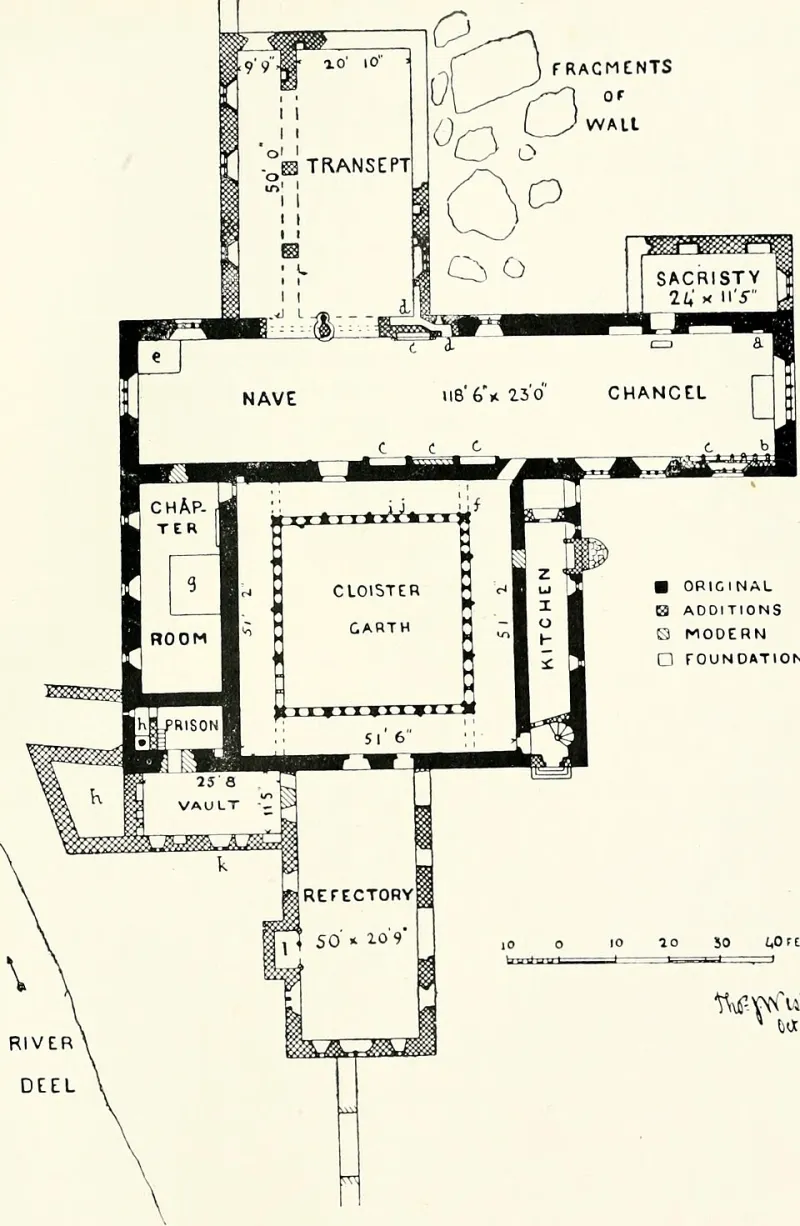
Photo: Internet Archive Book Images, No restrictions, via Wikimedia Commons
The modern burnout conversation tends to locate the problem somewhere between the open-plan office and the smartphone notification. It's a product of always-on culture, the argument goes — of gig work and Slack pings and the collapse of the boundary between professional and personal life. Fix the technology, fix the workplace, and the exhaustion will lift.
Spend some time in medieval monastic records and that story gets a lot more complicated.
A High-Performance System With No Exit
The Benedictine monastery of the early Middle Ages was, by design, a total institution. Monks didn't go home at the end of the day. They didn't have weekends in any meaningful sense. Their time was structured from before dawn to after dark by the Divine Office — the cycle of prayers, work, study, and community obligations that governed every hour. The Rule of Saint Benedict, written in the sixth century and still in use, was essentially an operating manual for a system that demanded constant output: spiritual, intellectual, and physical.
The work was real work. Monasteries ran scriptoria where monks copied manuscripts for hours at a stretch. They managed estates, maintained correspondence with political and ecclesiastical authorities, educated students, and performed medical care for surrounding communities. They were, by any reasonable measure, knowledge workers operating under conditions of sustained high demand with no clear boundary between work and identity.
The burnout showed up fast, and they documented it carefully.
Acedia: The Word They Had Before We Did
Fifth-century monk and theologian John Cassian gave the most detailed early account of what he called acedia, which translates roughly as listlessness or torpor but described something considerably more specific. Cassian's monk afflicted with acedia doesn't just feel tired. He feels that his work is meaningless, that his efforts are unrecognized, that he is uniquely trapped in a situation that others have somehow escaped. He loses the ability to concentrate. He becomes irritable. He finds himself watching the sun's position obsessively, waiting for the day to end. He fantasizes about leaving — about a different monastery, a different life, a different version of himself who isn't doing this.
If you've ever refreshed your email compulsively at 3 p.m. on a Tuesday and thought about quitting your job to open a coffee shop in Vermont, you've met Cassian's monk.
Acedia was classified as one of the eight logismoi — the dangerous thought patterns that monks were trained to recognize and resist — specifically because it was so common and so corrosive. It didn't just make monks unhappy. It made them useless, and it spread. A monk in the grip of acedia would, Cassian observed, begin to infect the community around him with his cynicism and his withdrawal. The psychological contagion of burnout in a close-knit workplace is not a modern discovery.
The Perfectionism Engine
What made monastic burnout particularly acute — and what connects it directly to contemporary professional burnout — was the moral dimension of the work. Monks weren't just doing a job. They were performing a vocation. Every failure of attention during prayer, every imperfectly copied manuscript, every moment of impatience with a difficult student was simultaneously a professional failure and a spiritual one. The system didn't allow for good enough. It only recognized perfect and fallen short.
This structure maps precisely onto the environments where modern burnout is most severe. Medicine, law, education, social work, tech startups with strong mission cultures — all of these share the feature that the work is not just work. It's identity. It's moral performance. Falling short isn't just a bad quarter; it's evidence of personal inadequacy. The psychological tax of that framing, compounded over months and years, produces an exhaustion that extra vacation days don't touch, because the problem isn't hours. It's the weight of the frame.
Medieval abbots understood this. The better monastic reform movements — the Cistercians in the twelfth century, various later reformers — explicitly addressed the perfectionism trap. They built in what we would now call structured incompleteness: acknowledgments that the monk's work was, by definition, never finished and that accepting that fact was itself a spiritual discipline. The goal wasn't to lower standards. It was to remove the psychological poison of treating every gap between ideal and actual as a moral crisis.
What the Records Say About Recovery
Monastic literature on recovering from acedia is surprisingly practical, and it clusters around a few consistent interventions.
The first is community restoration. Monks who had become isolated — physically or emotionally withdrawn from the rhythms of communal life — were brought back into low-stakes shared activity. Not high-demand work. Shared meals, manual labor alongside others, the ordinary texture of collective life. The goal was to interrupt the self-referential loop that acedia created. You can't ruminate effectively while shelling peas with six other people.
The second is what Cassian called perseverantia — not pushing through by force of will, but the quiet discipline of showing up at the minimum level until capacity returned. Not pretending to be well. Not performing recovery. Just being present in a reduced way while the system rebooted. Modern burnout research calls this behavioral activation and considers it one of the more evidence-supported recovery approaches. Cassian was recommending it in 420 CE.
The third, and most countercultural by contemporary standards, was the explicit acceptance of limits. The monastic tradition developed, over centuries, a theology of human finitude that functioned as a psychological protection. You were not supposed to do everything. You were not capable of doing everything. Believing otherwise wasn't ambition — it was the particular sin of pride, and it would break you. The monk who believed he could pray perfectly, work tirelessly, never flag, and never need rest was not a model to emulate. He was a cautionary tale.
The Wellness Portal Won't Save You
American workplace culture's current approach to burnout tends toward individual remediation: meditation apps, mental health days, resilience training, the occasional therapy benefit. These are not useless, but they share a feature with the worst monastic responses to acedia — they locate the problem in the individual rather than the system.
The monastery records that describe burnout most clearly also describe the systemic conditions that produced it: unrelenting demand, moral framing of every task, isolation from genuine human contact, and the removal of any legitimate path to saying this is too much. The monks who recovered were, almost without exception, the ones whose communities changed something — not just the ones who found better coping strategies.
That's the part of the historical record that doesn't make it into the wellness portal. The fix was never purely personal. It required the institution to acknowledge what it was doing to people.
The monks figured that out somewhere around the sixth century. We're still arguing about it.