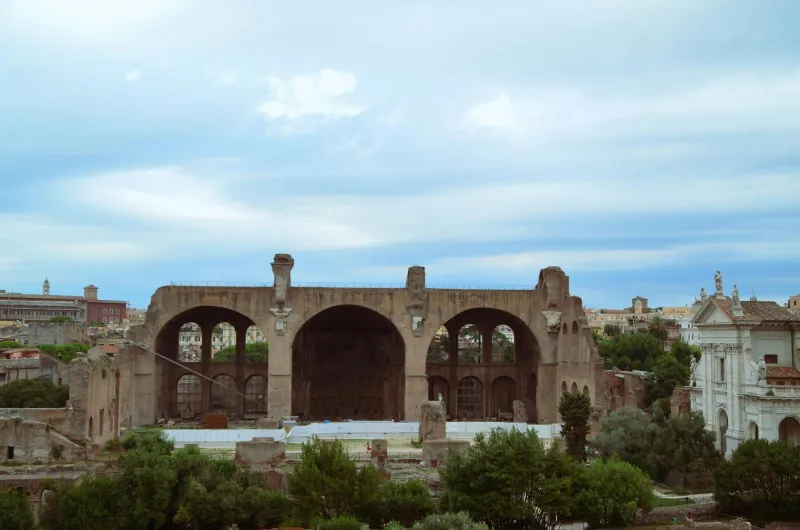
If you think your landlord is bad, consider Crassus. The richest man in Rome made his fortune by showing up at burning buildings with a private fire brigade, then refusing to put out the flames until the desperate owner sold him the property at rock-bottom prices. Once he owned it, he'd extinguish the fire and rent it back to the same family at triple the rate.
That was 50 B.C. The psychology hasn't changed.
The Numbers That Would Make San Francisco Blush
Roman workers in the first century A.D. spent between 30 and 50 percent of their income on housing — remarkably similar to today's "housing burden" threshold that economists use to define crisis. The average Roman apartment (called an insula) housed 30-40 people across multiple floors, with the poorest families crammed into windowless top floors that regularly collapsed or caught fire.
Young Romans couldn't afford to move out. Multi-generational housing wasn't a cultural choice — it was economic necessity. Sound familiar?
The poet Juvenal complained that "the rent of a dark hole here costs more than a whole estate in the countryside," a sentiment that would fit perfectly in a Brooklyn housing forum today. The psychological stress was identical: resentment toward landlords, anxiety about displacement, and the grinding humiliation of watching your income disappear into someone else's property portfolio.
When Politicians Promise Easy Fixes
Emperor Domitian tried rent control in 81 A.D., capping increases at what he considered reasonable levels. The result? Landlords stopped maintaining buildings, new construction plummeted, and the housing shortage worsened. Developers simply waited out the policy or found creative workarounds — charging separate "fees" for water access, storage, or building security.
The human brain wants simple solutions to complex problems. Rent control feels fair and immediate, which is why it's been tried in dozens of cultures across thousands of years. The psychology that makes it politically popular — our instinct to punish price-gouging and protect vulnerable tenants — is the same psychology that makes it economically counterproductive.
Emperor Trajan took the opposite approach, launching massive public works projects to increase housing supply. He built entire new neighborhoods, complete with shops, bathhouses, and apartments for different income levels. Modern urban planners would recognize his strategy: flood the market with supply to drive down prices through competition.
It worked — temporarily. But it required constant imperial investment and created a dependency cycle where citizens expected the government to solve housing through construction. When later emperors couldn't maintain the spending, shortages returned worse than before.
The Psychology of Housing Scarcity
Here's what every housing crisis reveals about human nature: we treat shelter as both a basic need and an investment vehicle, creating an inherent psychological conflict. Romans who owned property wanted values to rise; Romans who rented wanted them to fall. The same person could hold both positions simultaneously if they owned one property but wanted to buy another.
This cognitive dissonance explains why housing policy is so politically toxic. Every solution helps one group while hurting another, and people instinctively protect their existing investment even when they recognize the broader problem.
Roman landlords formed what we'd now call lobbying groups, arguing that rent control would destroy their incentive to provide housing. Roman tenants organized what we'd recognize as tenant unions, demanding protection from arbitrary evictions and price increases. The arguments on both sides were identical to today's housing debates, down to the specific talking points about property rights versus human dignity.
The Generational Resentment Machine
Perhaps most tellingly, Romans developed the same generational tensions around housing that poison American family dynamics today. Older Romans who owned property couldn't understand why young people complained about rent — they'd managed to buy when prices were lower, so why couldn't kids today just work harder?
Younger Romans resented being lectured about work ethic by people who'd benefited from cheaper housing, lower competition, and family wealth transfers. The psychological pattern is universal: each generation believes its struggles are unique while minimizing the advantages it inherited.
Roman writers documented the same family tensions we see today — adult children living with parents longer than anyone wanted, parents frustrated by kids who couldn't launch independent lives, and everyone blaming moral failings rather than structural economics.
Why Nothing Ever Changes
The Roman housing crisis lasted roughly 300 years, from the late Republic through the early Empire. It was "solved" only when urban populations collapsed during the empire's decline — hardly a model for modern policy.
This reveals the uncomfortable truth about housing psychology: the crisis feels urgent to individuals but operates on generational timescales that exceed political attention spans. Voters want solutions within election cycles; housing markets operate across decades. The mismatch between psychological time and economic time dooms most policy interventions.
Romans tried everything modern cities are trying: rent control, zoning reform, public housing, tax incentives for developers, and subsidies for buyers. Each policy worked for some people while creating new problems for others, generating the exact political coalitions we see today.
What Rome Actually Teaches Us
The lesson isn't that housing policy is hopeless — it's that the psychology driving housing crises is remarkably consistent across cultures and centuries. Understanding Roman failures can help us recognize why certain solutions feel appealing but consistently backfire.
Romans succeeded when they addressed housing as a complex system requiring multiple interventions over long time periods. They failed when they sought quick fixes that satisfied immediate political pressure but ignored economic fundamentals.
Most importantly, Romans learned that housing psychology is zero-sum thinking applied to a non-zero-sum problem. When people believe that someone else's housing gain must be their loss, policy becomes a battle between tribes rather than a technical challenge with engineering solutions.
Your rent isn't high because landlords are greedier than Roman landlords — it's high because the same psychological patterns that trapped Romans in expensive, overcrowded housing are playing out again with depressing precision. The good news? We know how this story ends. The bad news? It takes about 300 years.