Status Anxiety Is Structural: How Your Neighborhood Was Literally Built to Make You Feel Behind
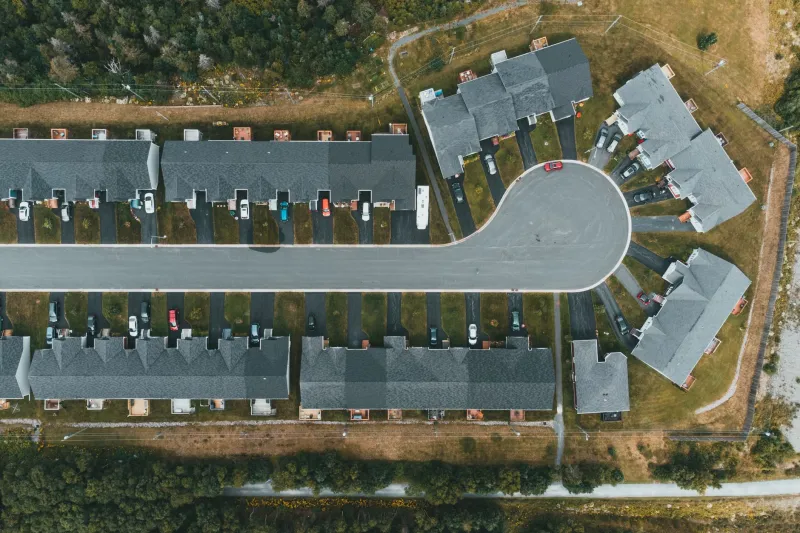
Let's say you're driving through a subdivision somewhere in suburban America — the kind of place where every house is a slight variation on the same four floor plans, where the driveways are long enough to display two cars comfortably, and where your neighbor's kitchen renovation is visible from your living room window because the houses are close enough that you can see their countertops if they forget to close the blinds.
You might assume this is a modern problem. A product of mass construction, tract housing, and a culture that turned homeownership into a competitive sport. You would be wrong on every count except the last one.
The psychology of residential comparison is not a suburban American invention. It's a documented feature of human settlement going back at least two thousand years, and the really unsettling part is that it appears to have been, at various points in history, deliberately designed in.
Pompeii Had an Open Floor Plan for a Reason
When archaeologists excavated Pompeii in earnest through the 18th and 19th centuries, they found something that surprised classicists raised on ideas of Roman private life: the homes of wealthy Pompeians were strikingly open to the street. The traditional Roman townhouse — the domus — was organized around a central atrium that was visible directly from the front entrance. When the door was open, passersby could see straight into the heart of the home.
This wasn't an accident or a security oversight. It was social technology. The Roman aristocratic home was a display device. The atrium contained the family's most valuable objects, its ancestral portrait busts, its finest furniture. Clients came every morning for the salutatio — a ritual greeting that was also a status assessment. The quality of what you saw when you walked through a man's door told you exactly where he stood.
Architecture historian Andrew Wallace-Hadrill spent considerable time documenting how Pompeian houses were calibrated for this kind of social performance — how room sizes, decoration quality, and spatial arrangement all communicated rank. The house wasn't just shelter. It was a resume you couldn't take down.
And the neighbors could see it. That was the point.
Victorian Suburbs Were Comparison Machines With Lawns
Jump forward roughly 1,800 years, and the logic reappears in a different climate with different materials. The Victorian suburbs that developed outside British and American cities in the mid-to-late 1800s were marketed explicitly as escapes from urban crowding — fresh air, green space, moral improvement. What they actually created was the most efficient status-comparison environment ever built up to that point.
The key innovation was the front lawn. Unlike urban row houses, where your facade was your statement, the suburban house sat back from the street on a visible plot of land. The lawn was public-facing by design. You couldn't fence it in Victorian America without signaling antisocial tendencies. It had to be maintained, displayed, and implicitly compared to your neighbor's.
Sociologist Thorstein Veblen was watching all of this happen in real time when he published The Theory of the Leisure Class in 1899, coining the term 'conspicuous consumption.' He specifically noted that residential display — the kept lawn, the parlor visible from the street, the quality of one's carriage house — had become a primary mechanism of social ranking in American middle-class life. He found it mildly ridiculous. He also found it completely predictable given how humans process relative status.
Veblen understood something that modern behavioral economists have since confirmed: we don't evaluate our material circumstances in absolute terms. We evaluate them relative to visible peers. And the suburb, by clustering similar-income families in proximity with maximum visual exposure, was a machine for generating that comparison constantly.
The Cul-de-Sac Closes the Loop
Post-World War II American suburbia took the Victorian model and made it inescapable. The cul-de-sac — that dead-end street curving back on itself — is often praised for creating community. What it also creates is a closed comparison group with nowhere to look except at each other.
On a cul-de-sac, you have maybe eight to twelve households who all chose roughly the same house at roughly the same price point. You see the same neighbors every time you pull out of your driveway. You know when someone gets a boat. You notice when the Hendersons redo their landscaping. The physical design ensures that your reference group is both stable and inescapable.
Psychologists call this 'reference group comparison,' and the research on it is extensive and consistent: humans care less about their absolute level of wealth than about their position relative to the people they can see. A 2010 study in the journal Psychological Science found that people would rather earn $50,000 in a community where everyone else earns $25,000 than earn $100,000 where everyone else earns $200,000. The math doesn't matter. The rank does.
The cul-de-sac didn't create this tendency. It just eliminated the variables.
Instagram Didn't Invent the Problem — It Exported the Neighborhood
Social media is frequently blamed for the current epidemic of social comparison and its documented effects on anxiety and self-esteem. The blame isn't entirely misplaced — platforms optimized for engagement will naturally surface content that provokes strong reactions, and envy is one of the strongest.
But what social media actually did was extend the neighborhood metaphor globally. Instead of comparing yourself to the eight households on your cul-de-sac, you now have access to a curated feed of people who are all performing the best version of their lives simultaneously. It's Pompeii's atrium, but the door is always open and everyone in the city can walk past.
The psychological mechanism is identical. The scale is the problem.
What Two Thousand Years of Keeping Up Tells Us
The through-line from Roman atria to Victorian lawns to Instagram grids is not that humans are uniquely shallow or materialistic. It's that social comparison is a functional feature of how we navigate hierarchies, and it operates on whatever information is available.
For most of human history, that information was limited by geography. You could only compare yourself to people you could physically see. Architecture, urban planning, and now digital platforms have all, in different ways, expanded or concentrated that visibility.
Suburban America didn't invent status anxiety. It just built it into the zoning code.