How Rome Turned Its Own Rulebook Into a Wrecking Ball — and Lost the Republic Anyway

Here's a thought experiment. Imagine you're a Roman senator in, say, 60 B.C. You can't outright kill a bill you hate — you don't have the votes. But you've got something better: time. The Roman calendar is riddled with religious holidays on which no official business can be conducted. Meetings must end at sundown. And a senator with enough lung capacity and political nerve can simply keep talking until the sun goes down and the session legally dissolves.
Sound familiar? It should. The filibuster didn't start with Strom Thurmond reading from a phone book for twenty-four hours and eighteen minutes to block the Civil Rights Act of 1957. It started in a marble building on the Capitoline Hill, roughly two thousand years earlier, with men who understood that the most durable weapon in any democracy isn't a sword — it's a procedure.
 Photo: Capitoline Hill, via c8.alamy.com
The Senate Was Designed to Slow Things Down. That Was the Point.
The Roman Senate was never supposed to be a fast-moving institution. That was a feature, not a bug. The Republic's founders — and the Founders of the American republic, who studied Rome obsessively — believed that deliberation was the antidote to mob rule. Slow things down. Make majorities work for their wins. Force consensus.
The problem is that any mechanism designed to slow majorities down can also be used to stop them entirely. Roman senators figured this out quickly. The most famous practitioner was Cato the Younger, a man so committed to obstruction that he essentially invented the senatorial filibuster as a political art form. When Caesar proposed land reform legislation in 59 B.C. that would redistribute public land to military veterans — popular with the public, catastrophic for the landed aristocracy — Cato simply refused to stop talking. He spoke until dark. The session ended. The bill died for the day.
 Photo: Caesar, via img.freepik.com
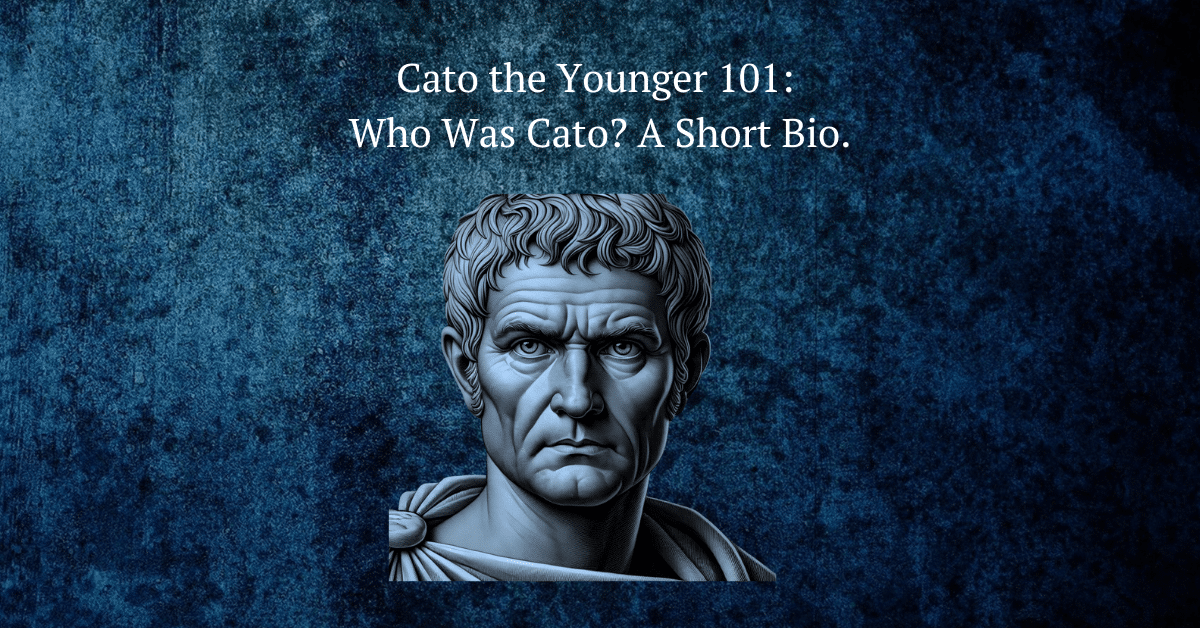 Photo: Cato the Younger, via stoicquotes.com
Caesar's response was instructive. He had Cato physically removed from the Senate floor. When other senators walked out in protest, Caesar took the legislation directly to the popular assembly, bypassing the Senate altogether. The rulebook had been weaponized. The workaround was to ignore the rulebook.
This is the part that should make American readers sit up a little straighter.
Obstruction Isn't Neutral — It Produces Its Own Kind of Radicalism
The standard defense of procedural delay — in Rome, in Washington, anywhere — is that it protects minorities from majoritarian excess. And that's true, as far as it goes. Unchecked majorities have done genuinely terrible things throughout history. Slowing them down has real value.
But here's what the Roman case reveals about human psychology: obstruction doesn't just delay outcomes. It changes how people feel about institutions. When Roman citizens watched the Senate repeatedly strangle popular legislation through procedural tricks, they didn't conclude that the Senate was wisely deliberating. They concluded that the Senate was rigged for the rich. That conclusion wasn't entirely wrong.
The psychological research on procedural fairness is pretty consistent on this point. People will accept outcomes they don't like if they believe the process was fair. But when the process itself appears corrupt — when the rules seem designed to produce predetermined outcomes regardless of popular will — legitimacy collapses fast. Romans watched this happen in real time across roughly a century of escalating procedural warfare, from the Gracchi brothers in the 130s B.C. through the final implosion of the Republic in the 40s.
By the time Caesar crossed the Rubicon, a significant portion of the Roman public had already mentally crossed it. The Senate had spent so long protecting its own interests through procedural manipulation that its claim to represent the Republic had become a punchline.
The American Parallel Is Uncomfortable Because It's Exact
The U.S. Senate filibuster, in its modern form, isn't constitutionally mandated. It's a Senate rule — specifically, a loophole that emerged from a 1806 rules cleanup that accidentally removed the mechanism for cutting off debate. For most of the Senate's history, it was used sparingly. Between 1917 and 1970, the Senate invoked cloture — the procedure to end a filibuster — a grand total of eight times. Between 2009 and 2020, it was invoked over 1,000 times.
That's not a gradual evolution. That's the same procedural arms race Rome ran, compressed into a few decades.
The Roman Senate's dysfunction didn't appear overnight either. It was a slow ratchet. Each faction normalized a slightly more aggressive use of procedure than the last one. By the time anyone recognized the institution was in crisis, the habits were too entrenched to reverse without a fight nobody wanted to have.
The Rule Becomes the Weapon Becomes the Justification
What makes the Roman story genuinely instructive — rather than just a depressing preview of American headlines — is what it reveals about the psychology of institutional decay. Democracies don't usually collapse because someone decides to destroy them. They collapse because everyone decides to protect their own position using the tools available, and the cumulative effect of individually rational decisions is collective catastrophe.
Cato wasn't trying to destroy the Republic. He was trying to protect what he saw as its core values against a man he correctly identified as dangerous. Caesar wasn't trying to become a dictator — at least not initially. He was responding to a Senate that had made normal political participation impossible for him through procedural exclusion.
Every step made sense from the inside. The outcome was a civil war that ended five hundred years of republican government.
The uncomfortable lesson isn't that obstruction is always bad or that majority rule is always good. It's simpler and harder than that: every democracy eventually faces the temptation to turn its own rulebook into a weapon. And the historical record suggests that once that temptation becomes standard practice, the rulebook stops meaning anything at all.
At which point someone — and there is always someone — proposes skipping the rulebook entirely.
Rome called that person Caesar. Every era gets its own version. The name changes. The psychology doesn't.